
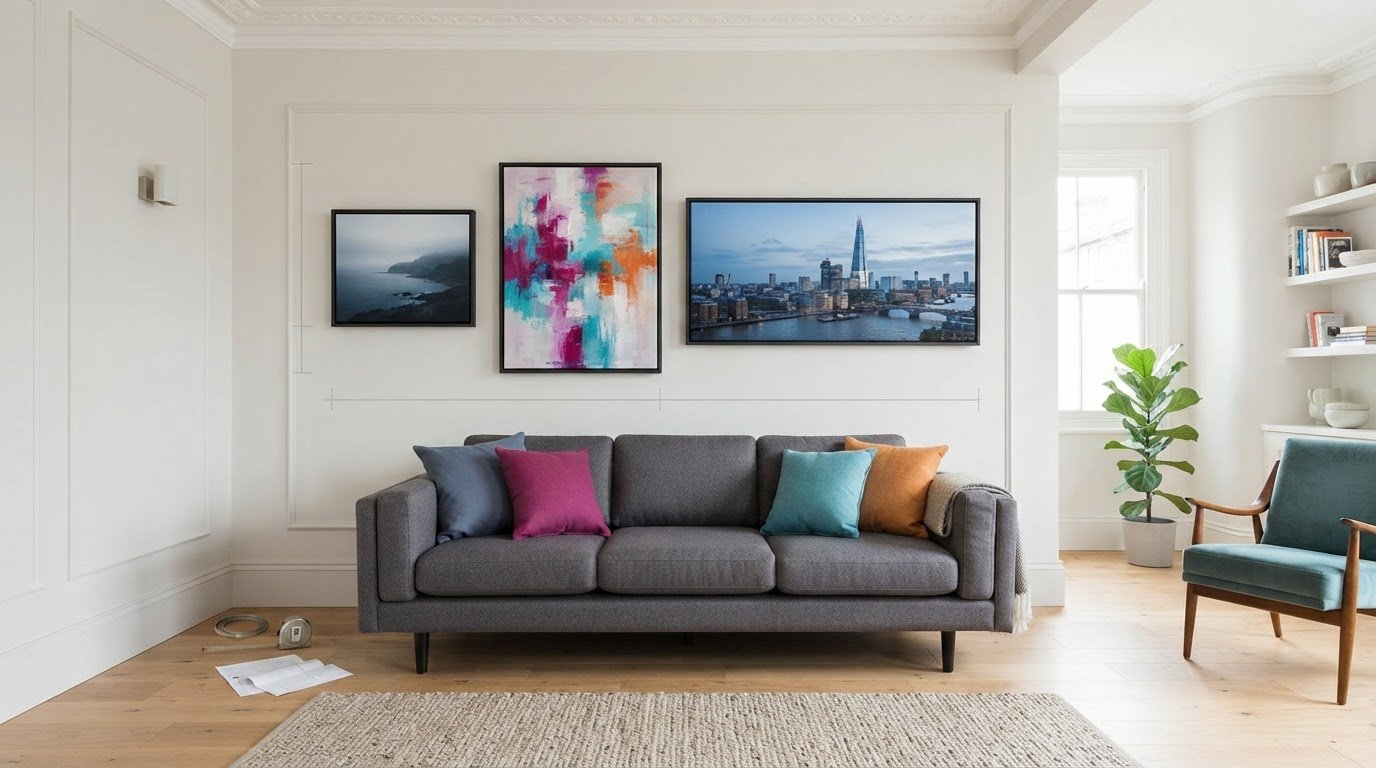
Choose a canvas size that suits both your photo and your wall. Match the canvas proportions to the image, or crop the photo to fit the space. Then compare the print’s width with the furniture below it: roughly two-thirds of the furniture’s width is a useful starting point. This canvas print size guide brings those choices together so your picture feels at home, not squeezed or lost.
It’s easy to focus on the image and overlook the wall around it. A favourite photo can look very different in print, and a size that feels right on screen may overwhelm a small space or seem too modest above a sofa.
Learn how to compare canvas sizes, measure your wall and choose a format that suits your photo. Aspect ratio, furniture width and paper templates can help you picture the finished result before deciding. Whether you want a subtle accent or a statement piece, the aim is a canvas that feels right in your home.
Key Takeaways
- Match the canvas shape to your photo, or crop the image thoughtfully so the main subject still works in the chosen format.
- Use the furniture beneath the canvas as a guide: a print around two-thirds of its width can create a balanced focal point.
- Compare popular sizes in centimetres and inches to picture how a small, medium or statement canvas will look in your room.
- Measure the wall and use a paper template to judge the finished size before choosing your print.
- Watch for common pitfalls, including overlooking the combined width of multi-panel art or choosing a canvas that competes with its surroundings.
How do I choose the right size for my wall space?
Measure the clear wall area and the furniture below it, then compare those dimensions with your photo. This canvas print size guide helps you balance the image’s shape with the available space.
Sizing Canvas Around Furniture
Canvas dimensions should suit both the furniture beneath the print and the clear wall space around it. This balance helps the artwork feel connected to the room, rather than too small above a sofa or crowded into a narrow section.
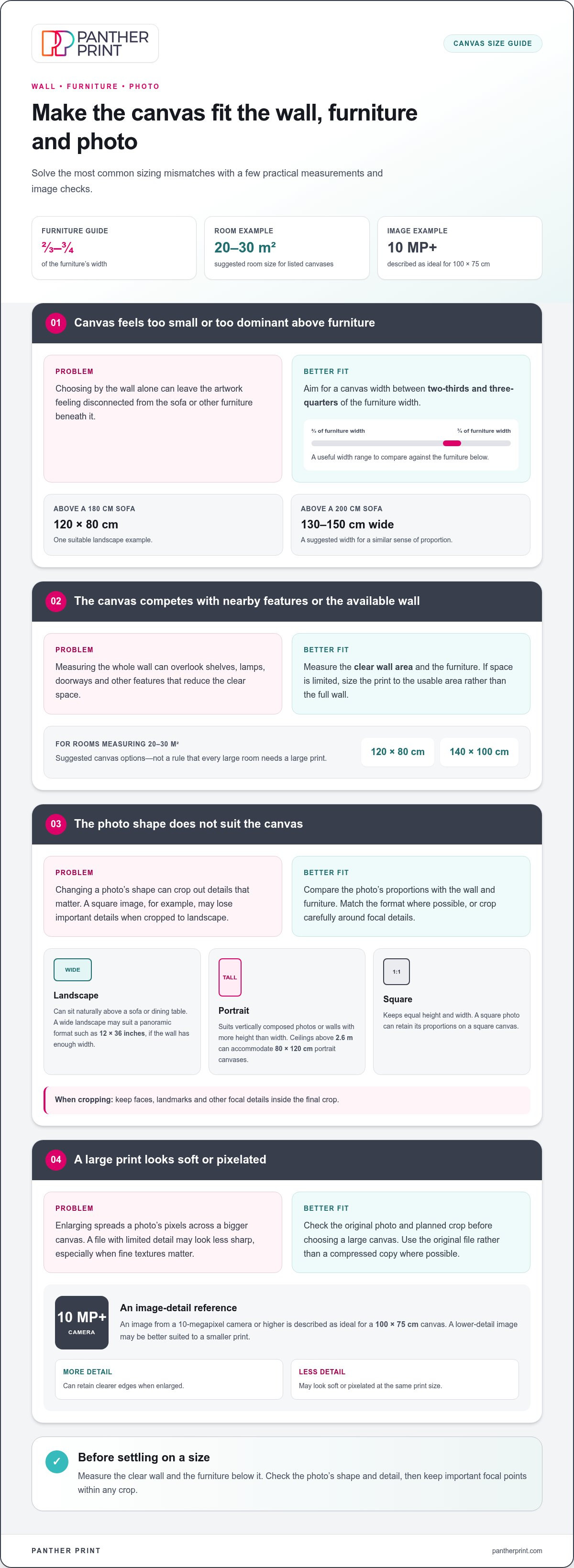
A canvas above furniture should generally measure between two-thirds and three-quarters of that furniture’s width. For a 180 cm sofa, a 120 × 80 cm landscape canvas is one suitable example. Above a 200 cm sofa, a width of 130-150 cm can create a similar sense of proportion.
A 75 × 50 cm canvas is another suggested option above a living-room sofa. Measure the furniture and the clear wall area, including nearby shelves, lamps or doorways. If the available wall is limited, size the print to that usable area rather than the full wall.
Room size can help refine your choice. For rooms measuring 20-30 m², 120 × 80 cm or 140 × 100 cm canvases are suggested options. Still, a large room doesn’t automatically call for a large print; the furniture width and surrounding wall space remain useful guides.
Choosing Landscape, Portrait or Square
Landscape canvases are wider than they are tall, portrait canvases are taller than they are wide, and square canvases have a 1:1 aspect ratio. Choosing the right format matters because it affects how the photo fits and how the artwork sits on the wall.
A landscape photo can sit naturally above a sofa or dining table, where its wide shape echoes the furniture. For a wide landscape, a panoramic canvas such as 12 × 36 inches can suit the image if the wall has enough width.
Portrait formats suit vertically composed photos or walls with more height than width. Rooms with ceilings above 2.6 m can accommodate portrait canvases measuring 80 × 120 cm. For a square photo, a square canvas preserves its proportions; cropping it into a landscape format may remove important details.
Compare your photo’s proportions with the wall and furniture before choosing a size. Cropping can adapt an image to the space, but keep faces, landmarks and other focal details within the final crop.
Photo Resolution and Print Size
Image resolution describes how much detail a photo file contains, while DPI describes how densely that detail is printed. Enlarging a photo spreads its pixels across a larger canvas, which can make the print look less sharp if the file contains limited detail.
The right canvas size depends partly on the original photo, not just the wall. An image from a 10-megapixel camera or higher is described as ideal for a 100 × 75 cm canvas. A lower-detail image may be better suited to a smaller print, especially when fine textures matter.
DPI helps explain why photos of the same subject can look different at the same print size. A detailed image can retain clearer edges when enlarged, while a low-resolution image may look soft or pixelated.
Use the original photo file rather than a compressed copy where possible. Before choosing a large canvas, inspect the image and planned crop closely. Cropping out much of the original photo leaves less detail for the finished print. Use this canvas print size guide to weigh image quality against wall dimensions.
What are the most popular canvas print sizes?
Canvas sizes range from compact prints to large statement pieces, with dimensions listed in inches or centimetres. Compare the measurements with your photo and available wall space before choosing.
Standard Sizes and Unit Conversions
Standard canvas sizes are familiar dimensions offered in inches or centimetres, and comparing both makes it easier to picture the print at home. For a useful reference, one inch equals 2.54 cm, so a canvas listed in inches can be compared with a wall measured in centimetres.
- Medium: 10 × 8 inches measures 25.4 × 20.32 cm; 12 × 8 inches measures 30.48 × 20.32 cm.
- Large: 20 × 16 inches measures 50.8 × 40.64 cm; 30 × 20 inches measures 76.2 × 50.8 cm.
- Extra large: 40 × 30 inches measures 101.6 × 76.2 cm; 60 × 40 inches measures 152.4 × 101.6 cm.
These conversions help you judge the real footprint, rather than relying on a size label alone. For example, a 30 × 20-inch canvas is more than 76 cm wide, so it needs a noticeably broader stretch of wall than a medium print.
Small, Medium and Large Canvases
Size categories describe the canvas’s overall scale, helping you narrow your choice by the effect you want. A 30 × 25 cm or 40 × 30 cm canvas suits a smaller picture or a gift, whilst a 60 × 40 cm canvas is a versatile medium option.
For a more prominent display, 100 × 75 cm is a suggested large statement size. Extra-large formats include 40 × 30 inches and 60 × 40 inches, giving a single image more presence across a broad wall. The larger the print, the more important it is to consider the image’s detail and the space around it.
Medium canvases can also work well in groups. A 50 × 40 cm size is listed as a popular choice for a photo collage, where several pictures share the display. Square formats offer another option: a 20 × 20-inch canvas measures 50.8 × 50.8 cm, keeping equal height and width for a balanced picture.
Panoramic Ratios and Sizes
A panoramic canvas is much wider than it is tall, making it well suited to broad landscapes and long horizontal compositions. Its shape gives a wide photo room to breathe, but it needs enough uninterrupted wall width.
Examples include a 60 × 16-inch canvas, measuring 152.4 × 40.64 cm, and a 10 × 30-inch canvas, measuring 25.4 × 76.2 cm. A 40 × 10-inch option measures 101.6 × 25.4 cm. Compare the ratio of your photo with the canvas dimensions, since a mismatch can crop important details.
A large print can look blurry if the original image has limited detail, is heavily compressed or has been enlarged digitally. Cropping away much of the image can also reduce the detail available in the final picture. For expressive, non-photographic wall art, browse abstract canvas prints in a format that suits your wall.
How do I choose the right size canvas for my photo?
Match the canvas proportions to the photo’s orientation and subject, then check how its full dimensions will sit on the wall. Leave 15-20 cm above a sofa back, or 20-30 cm above a mantelpiece; for a gallery grid, allow around 5-7 cm between canvases.
Matching Dimensions to Photo Orientation
Photo orientation describes whether an image is horizontal, vertical or square. Matching the canvas shape to the photo helps preserve its composition. Changing the proportions can crop faces, scenery or other details from favourite memories.
For a horizontal family photo, choose a wider canvas to keep people and background in view. A vertical portrait can suit a taller format, while a square image fits a square canvas without cropping. If you change the orientation, preview the crop and check that important details remain within the new dimensions.
Previewing Sizes with Templates and Tape
A paper template or tape outline shows the proposed canvas footprint on the actual wall. It helps you judge the scale beside furniture, shelves and other artwork before choosing a size.
Cut paper to the exact canvas dimensions, or mark those edges with masking tape. Step back from the wall and view the outline from the main seating position. Live with a paper template for 24 hours before ordering; changing its position can reveal whether the size feels right in the room.
For a group of prints, mark each canvas separately and leave around 5-7 cm between pieces in a gallery grid. This makes the full arrangement easier to assess than testing one print alone.
Including Frames and Shadow Gaps
The listed canvas dimensions may differ from the finished artwork’s overall dimensions if it includes a frame and shadow gap. Allow for the full footprint, since the extra width and height affect how the piece fits beside furniture or within a measured wall space.
Use the overall outside measurements when making a template, rather than outlining only the printed canvas area. For a framed piece, include the frame edges and visible gap in your wall plan. This gives you a more accurate preview of the finished artwork’s footprint.
A-Series Canvas Dimensions
A-series paper sizes offer familiar references for judging canvas scale. An A4 sheet is about 30 × 21 cm, whilst A3 is about 42 × 30 cm, giving you quick visual comparisons before selecting larger artwork.
Hold an A4 or A3 sheet against the wall to see how its proportions relate to the photo. These are comparison points, not necessarily the final canvas dimensions. If the chosen canvas is larger, mark its exact width and height with tape; the paper’s outline alone won’t show the finished footprint.
Finally, compare the outline with the original photo. A horizontal image may need a wide crop, while a portrait needs enough height to preserve its subject. This final check helps the print suit both the room and the image.
Measuring a wall and applying the two-thirds rule
Measure the usable wall area first, then compare the canvas or gallery arrangement with the furniture below. A canvas should cover roughly 60-75% of the available wall space, while artwork above furniture is commonly planned at about two-thirds of its width.
Start by measuring the furniture’s full width, then check the clear wall above it. Include nearby shelves, lamps and doorways when judging usable space. For a 210 cm-wide sofa, a suitable canvas or gallery arrangement is around 138 cm wide. That leaves visible wall on either side, helping the display feel connected to the sofa without filling the whole wall.
The two-thirds rule is a practical starting point, not a reason to ignore the wall’s shape. A wide, low wall may suit a horizontal canvas, while one large print can feel crowded on a narrow wall. Compare the proposed dimensions with both the furniture and the available wall space. For several prints, measure the complete arrangement, including the gaps, rather than sizing each canvas in isolation.
Framed, gallery-wrapped and panoramic describe different features. Framed and gallery-wrapped refer to how the canvas edges are finished; panoramic describes a wide format. Compare the edge finish and overall dimensions with your room, then choose a format that suits both the photo and the display.
For a family gallery wall, lay out the complete group before deciding where it will go. A classic grid might use four, six or nine canvases of the same size and shape. Centre the arrangement over the furniture, and include the gaps between prints when measuring its total width and height. This helps you judge whether the group balances the wall better than one large canvas.
On a stairway, a 60 × 40 cm family portrait can act as the central piece in a gallery arrangement. In a long hallway, three matching 30 × 40 cm prints spaced 10 cm apart create a gallery effect. Smaller prints can work as a group, whilst one larger piece gives a single photo more presence. For a grid, allow around 5-7 cm between canvases.
The material and format affect a canvas’s finished look, so compare the surface and edge presentation as well as the size. A framed edge gives the artwork a defined border, while a gallery-wrapped edge leaves the canvas visible around the sides. Check that your photo has enough detail for the chosen dimensions, especially for a large canvas viewed closely.
Before choosing, mark the arrangement’s outer edges on the wall with tape. Step back and compare its width with the furniture below. Adjust the outline until the display looks balanced, then use those measurements to guide your canvas choice.
Common canvas sizing mistakes
A display can feel unbalanced if the canvas, photo and wall space don’t work together. Check the complete arrangement before choosing a size, especially for multi-panel prints and artwork above beds.
One common mistake is choosing a size based on the photo alone. A picture that fills a phone screen may look small on a broad wall, while a tightly cropped image can lose important details when enlarged. Compare the image’s proportions with the canvas, then inspect the crop at the intended dimensions. Keep faces, landmarks and other focal points clear of the edges.
Another mistake is measuring only the printed image, not the whole display. For a group of canvases, include every panel and the spaces between them. Mark the arrangement’s outer edges on the wall, then stand back and check its balance with nearby furniture. A single large canvas and a multi-panel display need different wall footprints, even if their total artwork area seems similar.
Sizing Diptychs and Triptychs
A diptych has two panels, while a triptych has three, so the combined width matters more than the dimensions of one panel. This helps prevent a multi-piece display from spreading beyond the available wall space.
Measure each panel and include the gaps in the total width. If the listed dimensions apply to individual panels, don’t simply multiply the panel width: add the spaces between pieces too. Lay out paper templates for every panel before choosing, and check that the arrangement still reads as one focal point.
Choosing Canvas Size Above Beds
Canvas width above a bed should relate to the bed’s width, keeping the artwork in proportion with the furniture. For a UK double bed measuring 135 cm wide, a canvas width of 80-100 cm is recommended; for a 150 cm king-size bed, the suggested width is 100-120 cm.
Measure the bed frame, not just the mattress, then centre the canvas above it. A print narrower than the suggested range may look undersized, while a much wider one can dominate the bed. Use a paper outline to compare the dimensions with the headboard and surrounding wall before deciding on the display.
Before ordering, run through three checks: measure the full wall arrangement, compare the canvas proportions with the photo, and preview the outline at its intended position. These steps catch sizing errors before they become part of the room. For a personal image, choose a photo on canvas that fits the space and keeps the important details in view.
Panther Print: Abstract Canvas Prints
Panther Print offers Abstract Canvas Prints for rooms that need colour, movement or a striking focal point. Browse abstract designs alongside Animals & Wildlife, Art for Kids & Nursery Art and Banksy Canvas Prints. Measuring the wall first helps you decide whether one canvas or a group will suit the space.
Panther Print also offers Photo on Canvas, turning a favourite image into wall art. Compare the photo’s orientation with the canvas shape, then consider how its dimensions will sit above your furniture. This gives you a practical starting point for choosing a print that feels at home in your room.
Explore the canvas print options at Panther Print.
Give your chosen image a place to shine
Let the image set the mood for your room. A family photograph can make a quiet corner feel personal, while expressive artwork can bring colour and character to a shared space. Use this canvas print size guide as a starting point, then choose a picture you’ll enjoy seeing every day.
Panther Print offers Abstract Canvas Prints, Animals & Wildlife, and Art for Kids & Nursery Art. Each subject can create a different feel, from playful touches in a child’s room to a bold centrepiece in the living room. Choose an image that suits the space and the people who use it.
Ready to explore a picture for your wall? Contact Panther Print for canvas advice and take the next step towards artwork that feels at home in your space.
Frequently Asked Questions
Is it better to go too big or too small with wall art?
A slightly larger piece can make a stronger focal point, provided it suits the wall and furniture. Artwork that’s too small may look disconnected, while an oversized canvas can crowd nearby shelves or windows. Compare the print with the clear wall area, not the room’s entire width. A taped outline helps you judge the scale from the doorway and main seating position.
What size wall art works best above a sofa or fireplace?
Above a sofa, choose artwork roughly two-thirds of its width; for a 180 cm sofa, a 120 × 80 cm landscape canvas is one suggested fit. Above a standard 120 cm fireplace, an 80-90 cm-wide canvas is recommended. Keep the fireplace piece within the mantel’s visual width, and check its shape against the available wall height so it doesn’t compete with the mantel.
What is the most popular canvas size for a living room?
There isn’t one canvas size that suits every living room, but 75 × 50 cm is a suggested option above a sofa. For a stronger statement, 100 × 75 cm is a large format to consider when the wall has room. Choose by the sofa’s width, the image’s proportions and the amount of open wall, rather than by room name alone.
What size canvas do I need for a bedroom wall?
Let the bed width guide the canvas size. Above a UK double bed measuring 135 cm wide, an 80-100 cm-wide print is recommended; above a 150 cm king-size bed, consider 100-120 cm. A horizontal image can sit comfortably above a headboard, whilst a portrait format may suit a narrow wall beside the bed. Keep the artwork centred with the bed.
What are standard canvas print sizes in the UK?
Common canvas sizes include 10 × 8 inches, which measures 25.4 × 20.32 cm, and 16 × 12 inches, which measures 40.64 × 30.48 cm. Larger examples include 20 × 16 inches at 50.8 × 40.64 cm and 30 × 20 inches at 76.2 × 50.8 cm. Check whether a size is listed in inches or centimetres before comparing it with your wall measurements.
How do I choose a canvas print size for a wall?
Measure the clear wall area and note anything that affects the display, such as a doorway, radiator or shelf. If the canvas will hang above furniture, compare its width with that item rather than the whole wall. For a collection, measure the outer edges of the complete arrangement, including the gaps. A paper outline helps you assess the result from different parts of the room.
What canvas size works best above a sofa or bed?
Choose a canvas that relates to the furniture’s width, then check the photo’s orientation. A 200 cm sofa can suit a canvas 130-150 cm wide. For beds, an 80-100 cm width is suggested above a 135 cm UK double, while a 150 cm king-size bed suits 100-120 cm. Keep the composition centred over the furniture for a neat, connected display.
What image dimensions are needed for common canvas print sizes?
There’s no single pixel dimension for every canvas size; the image’s detail and crop both affect how it prints. A 10-megapixel camera image is described as ideal for a 100 × 75 cm canvas. Use the original photo file where possible, and match its proportions to the print so cropping doesn’t remove important details. Inspect the image closely before enlarging it.