
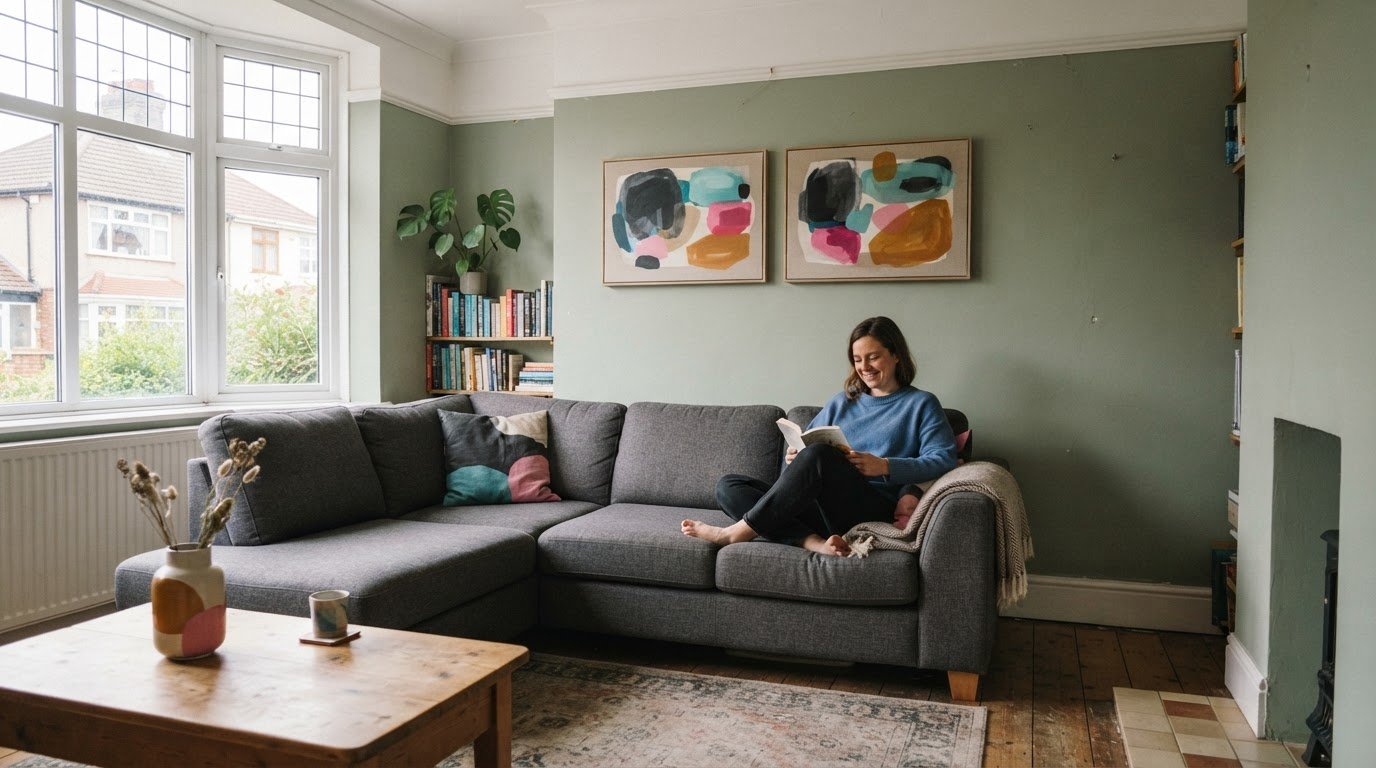
The best fit isn’t usually as wide as the sofa. To decide what size canvas works above a sofa, aim for artwork or a grouped display that spans roughly two-thirds to three-quarters of its width. Hang the centre of the artwork about 145-152 cm from the floor, while keeping the bottom edge around 20-25 cm above the sofa back.
Getting the scale right can feel tricky: a single canvas, a pair of prints and a wider gallery-style display each use the wall differently. For a group, measure the full arrangement, including the gaps between prints, to check its overall width before hanging.
This guide gives you practical size examples for different sofa widths, along with tips for measuring your wall and choosing a comfortable hanging height. You’ll also learn how to account for gaps between grouped prints, helping your artwork feel balanced, centred and at home above the sofa.
Key Takeaways
- Adjust the canvas position to suit a low- or high-backed sofa, and keep the space above it feeling balanced.
- Measure grouped prints as one display, including the gaps between each piece.
- Use your sofa’s width to narrow down canvas dimensions, then check how the full shape will sit on the wall.
- Explore different subjects and formats to find artwork that suits your room and the space above your sofa.
Hanging height above low- and high-backed sofas
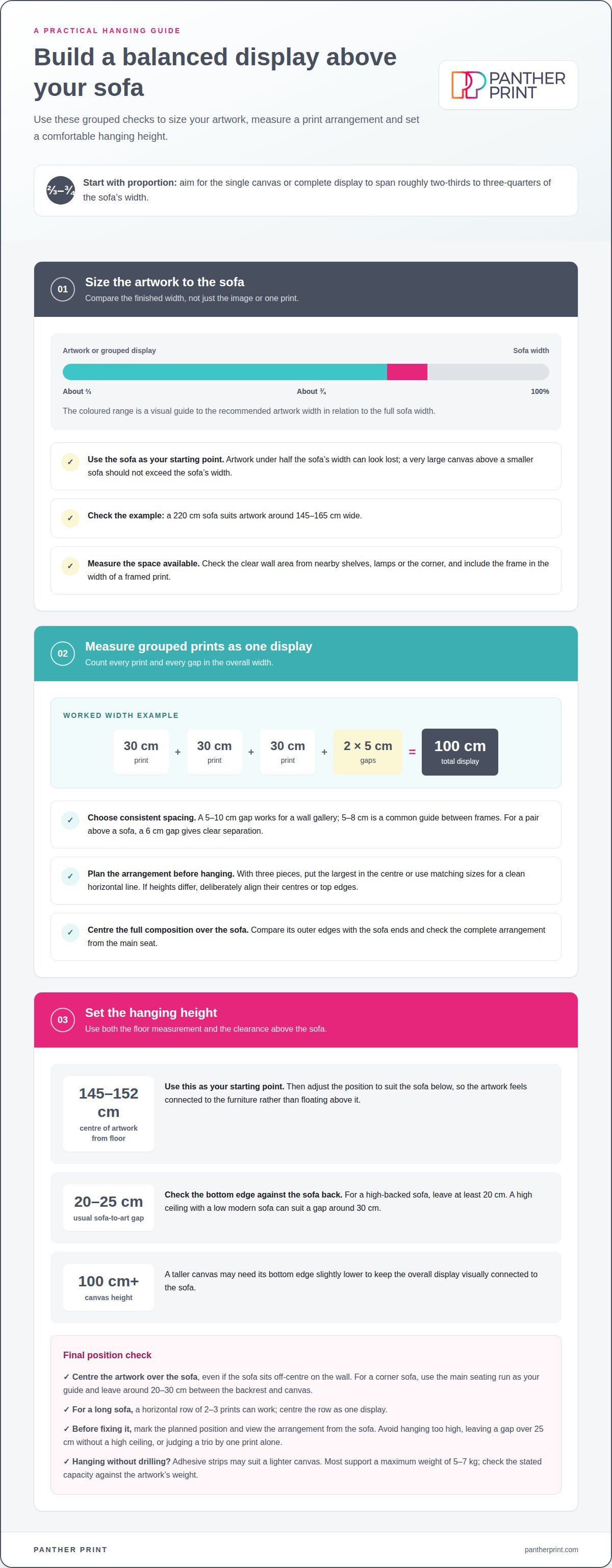
- Start by measuring from the floor and the sofa back. Aim for the centre of the artwork to sit 145-152 cm above the floor. This gives you a useful starting point, not a reason to ignore the furniture below. Above a low-backed sofa, leave a modest gap between the furniture and the frame, adjusting it to the sofa and artwork so the display feels connected. That clearance helps the canvas relate to the sofa instead of floating high on the wall above it.
- Adjust the gap to suit the sofa and canvas. For a high-backed sofa, leave at least 20 cm between the backrest and the frame’s bottom edge. A 20-25 cm gap is a practical guide for most sofas, whilst a high ceiling and low modern sofa can suit a gap around 30 cm. If the canvas is 100 cm tall or more, its bottom edge may need to sit slightly lower to keep the whole display connected.
- Centre the artwork over the sofa, even when the sofa sits off-centre on the wall. For a long sofa and wide wall, consider a horizontal row of 2-3 prints. Treat the row as one display, then centre that overall shape above the seating. At a corner sofa, use the main seating run as your guide and leave around 20-30 cm between the backrest and canvas. Avoid centring a print on the entire wall if that leaves it visually detached from the sofa.
- For hanging without drilling, adhesive strips may suit a lighter canvas. Most support a maximum weight of 5-7 kg, so check the strip’s stated capacity against the artwork’s weight. Avoid relying on strips beyond their limit. Common mistakes include hanging the canvas too high, leaving a gap over 25 cm without a high ceiling, or judging a trio by one print alone. Mark the planned position first, then view the arrangement from the sofa before fixing it.
Can a canvas print be wider than the sofa?
- Use the sofa’s width as your starting point. A single canvas or complete arrangement should span roughly two-thirds to three-quarters of the sofa. For example, a 220 cm sofa suits artwork around 145-165 cm wide. A piece under half the sofa’s width can look lost, whilst a very large canvas above a smaller sofa should not exceed its width. This gives you a practical starting point for deciding what size canvas to hang above a sofa.
- Check the clear wall area before settling on a wider format. Measure from nearby shelves, lamps or the corner, then compare that space with the sofa width. In an open-plan room, a statement artwork measuring 150 cm or more can anchor a large sofa. Keep the sofa as your visual centre, even if it sits off-centre on the wall. A high ceiling gives more vertical room, but doesn’t automatically call for a wider canvas.
- When choosing a photograph, consider how it will be cropped. Check that people, scenery and other important details will remain visible in the finished format. A small image with a tight crop may look softer when enlarged, so don’t judge its suitability by width alone. A landscape photograph may work naturally in a horizontal format above the sofa, while a portrait subject may need a different composition. Before buying, use paper to outline the proposed dimensions on the wall.
- Use the outside measurement when comparing a framed print with the sofa. An unframed canvas is measured by its canvas dimensions; for a framed piece, include the frame in the total width. This makes the comparison reflect the space the finished artwork will occupy. If you’re still weighing up what size canvas to choose above your sofa, focus on its overall shape and colour balance too. Explore canvas formats to picture how a horizontal design could sit above your sofa.
Measuring grouped prints including gaps
- Measure the full group, not just one canvas. Add every print’s width, then include each space between neighbouring prints. For example, three prints measuring 30 cm wide each, with two 5 cm gaps, create a 100 cm-wide composition. That total is the measurement to compare with your sofa and available wall space. Small prints can make a substantial display when their combined width is planned carefully.
- Choose one gap and repeat it across the arrangement. Spacing of 5-10 cm works for a wall gallery, with 5-8 cm a common guide between frames. For a pair above a sofa, a 6 cm gap gives a clear separation without splitting the composition. Measure from the outer edge of one print to the outer edge of the next, rather than estimating by eye.
- Arrange the prints in their intended order before hanging them. Keep the overall composition balanced, especially when combining larger and smaller canvases. With three pieces, place the largest in the centre or use matching sizes for a clean horizontal line. If the prints are different heights, deliberately align their centres or top edges. Avoid letting a smaller print appear disconnected from the group.
- Check the arrangement against the furniture below. Centre the complete display over the sofa, then see how its outer edges line up with the sofa ends. A group that looks wide on the floor may feel compact on the wall, so assess the full composition from the main seat. Keep the gaps even and the bottom edge visually level, even if the individual artworks have different shapes.
Canvas size examples for different sofa widths
Match the canvas or gallery arrangement to your sofa’s width, then check that its shape suits the room. Use these examples as a starting point for choosing balanced proportions.
-
Compare canvas sizes across sofa widths
Measure the sofa, then use these examples to shortlist canvas dimensions. For a sofa 130-150 cm wide, consider artwork 90-110 cm wide, such as a 100 × 50 cm landscape or 90 × 90 cm square. A sofa 160-180 cm wide suits artwork around 110-135 cm, including 120 × 60 cm or 120 × 80 cm formats.
For a 190-220 cm sofa, look at 130-160 cm-wide artwork; a pair of 60 × 90 cm portrait canvases can also work side by side. In a small living room, try a 90 × 90 cm canvas or a 100 × 50 cm landscape above a compact sofa. Keep nearby furniture and the wall’s open space in view, so the colour and proportions don’t overwhelm the room.
-
Choose a canvas size for a sectional sofa
Measure the main seating run of a sectional or corner sofa, then size the display against that stretch. Leave around 20-30 cm between the backrest and canvas, and centre the artwork over the main section rather than the entire corner shape. A group can follow the sofa’s horizontal line, but count the complete arrangement as one display when judging its width.
For a 2.4-metre sofa, artwork around 145-180 cm wide is a useful guide. A wide sectional may suit a gallery of prints if one canvas feels too narrow; keep the group’s outer edges within the seating area. Check the view from the main seat, where an arrangement that looks balanced on the floor can feel different above the sofa.
-
Review standard canvas sizes in the UK
Compare available formats with the measurements you need, rather than assuming one set of standard UK canvas sizes fits every sofa. Examples include 90 × 90 cm, 100 × 50 cm, 120 × 60 cm and 120 × 80 cm. The first measurement indicates one side, so check which dimension will run horizontally before choosing portrait or landscape orientation.
For a smaller living room, choose a format that leaves visible wall space around the artwork and doesn’t crowd shelves or lamps. A paper outline lets you see the canvas’s footprint and colour balance before hanging. Browse canvas sizes and formats to compare designs with your measurements.
Panther Print
Panther Print offers canvas wall art for the space above your sofa. Measure the sofa and choose a suitable overall width, then browse designs to find a subject and style that feel right in your living room.
Browse themes including abstract designs, animals and wildlife, children’s art and Banksy prints. Compare each canvas’s proportions with the space you’ve measured, and consider how its colours will work with your furniture. If you’re choosing between one canvas and a group of prints, use the measurements in this guide to find a format that fits your wall.
Ready to explore artwork for your sofa wall? Contact Panther Print for help finding a canvas that suits your space.
Give your sofa wall a personal touch
Choosing what size canvas to hang above your sofa is also a chance to shape the feel of your living room. Let the artwork connect with colours already in your cushions, rug or favourite accessories. If you want a striking focal point, exploring original contemporary works on sites like artgal.online can provide inspiration for unique paintings that bring warmth and character to your seating area. The right choice should feel at home with the way you use the room, not just the measurements on a page.
Picture the wall in daylight and evening light before deciding. Notice which colours stand out and whether the room feels calm, lively or ready for a change. Taking a moment to consider the overall effect can help you choose artwork you’ll enjoy living with every day.
Ready to explore ideas for your sofa wall? Ask Panther Print about your canvas, and take the next step towards a space that feels unmistakably yours.
Frequently Asked Questions
How high should you hang it?
Place the artwork’s centre about 145-152 cm from the floor. To find the bottom edge, halve the canvas height and subtract that from your chosen centre point. For example, an 80 cm-tall canvas centred at 148 cm would start around 108 cm above the floor. Check the planned position from your usual seat before marking the hanging point.
What is the ideal size painting for above a 3-seater sofa?
For a typical three-seater sofa, around 120-140 cm of artwork width is a useful guide. A canvas measuring 120 × 90 cm or larger can also suit, depending on the available wall and the image’s shape. A landscape subject often fills the width neatly, whilst a square or portrait composition creates a different focal point. Consider the room’s balance before choosing.
How do you choose the right canvas print size for a wall?
Measure the clear wall area rather than the full wall. Allow for shelves, lamps and other features, then compare the remaining space with your sofa and preferred artwork shape. Outline the canvas on the wall with paper to judge its footprint before choosing. If you’re using a photograph, consider the crop too, so important details remain visible at the finished size.
How far above the sofa should artwork be hung?
Measure from the sofa’s backrest to the artwork’s bottom edge, using the highest point if the back is uneven. Around 20-25 cm suits many arrangements; a low-backed sofa may need 25-30 cm. For a high-backed sofa, keep at least 20 cm of clearance. These measurements help you avoid placing the artwork where it feels disconnected from the seating.
One piece, two pieces or three?
Choose one canvas for a simple focal point, or two or three prints to extend the display across a wider sofa. Let the subject guide the arrangement: one landscape can read as a single scene, while separate images can add variety. Before hanging, view the complete group together rather than judging each print on its own.
One large piece or a set of three above the sofa?
Choose one large piece for a clear focal point and an uninterrupted image. A group of three can create a broader gallery effect, especially when the images share a colour or theme. A trio needs enough wall width to feel balanced, while a single canvas can suit a simpler layout. Consider which format works best with your furniture and other artwork.