
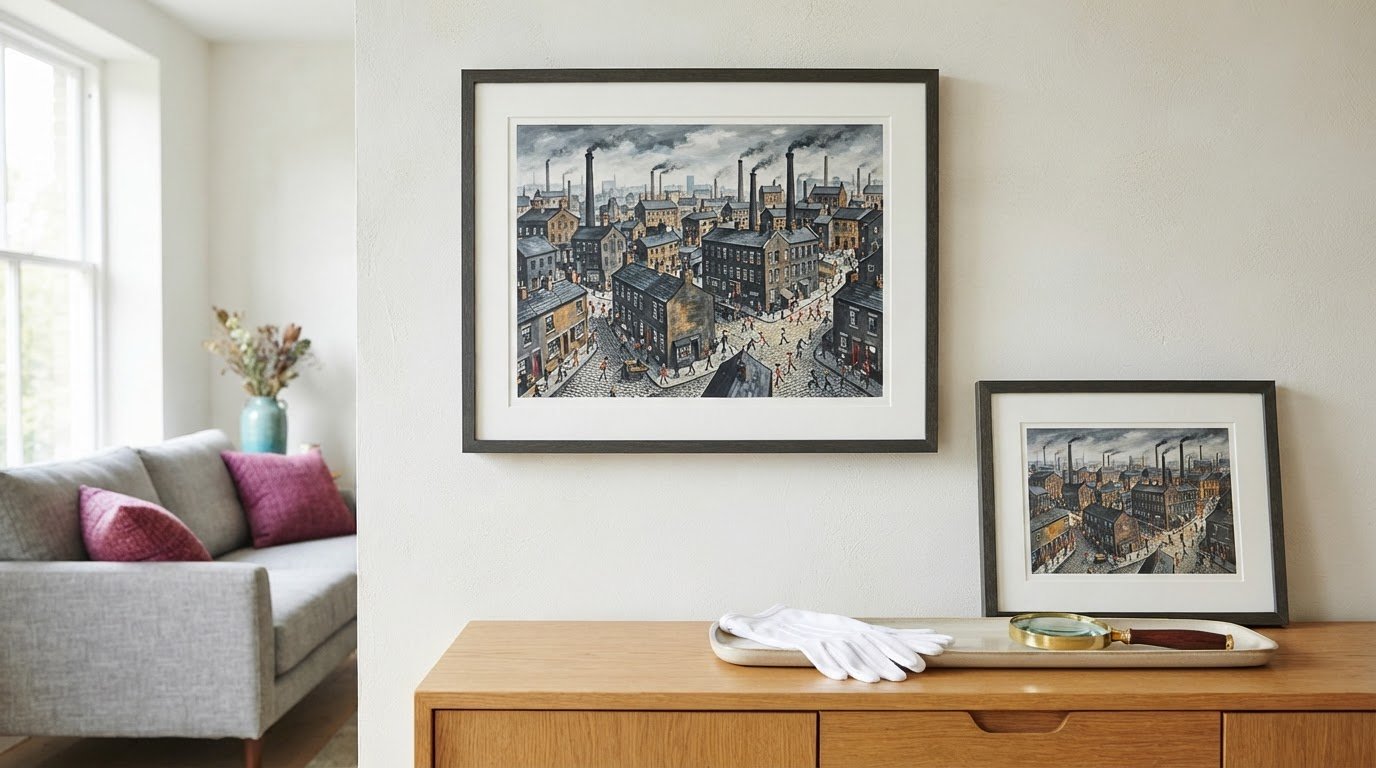
Lowry prints range from decorative reproductions to signed editions and original lithographs. Their value depends on the print’s type, signature, condition and subject, so images of the same scene can attract very different interest.
Lowry’s matchstick figures, busy streets and smoking mill chimneys bring everyday industrial life to the wall. This guide explains what affects prices, what to look for in signed limited editions, and which city scenes define his work. Edition details and subject matter can help you compare examples. Whether you’re choosing artwork for your home or exploring the collecting market, use these pointers to find prints that suit your interests and know what to check before deciding.
Key Takeaways
- Learn why a signed edition and an unsigned decorative reproduction can have very different values.
- See which details, including the signature, edition and condition, help distinguish one print from another.
- Explore how Lowry’s crowded streets, mills and everyday scenes shape the appeal of his work.
- For a different look at home, explore abstract canvas prints as an alternative wall-art style.
Prices of individual Lowry prints
Prices range from modest decorative reproductions to valuable signed editions and original lithographs. Before judging an asking price, compare the print’s type, signature, condition and subject.
Individual and Framed Print Prices
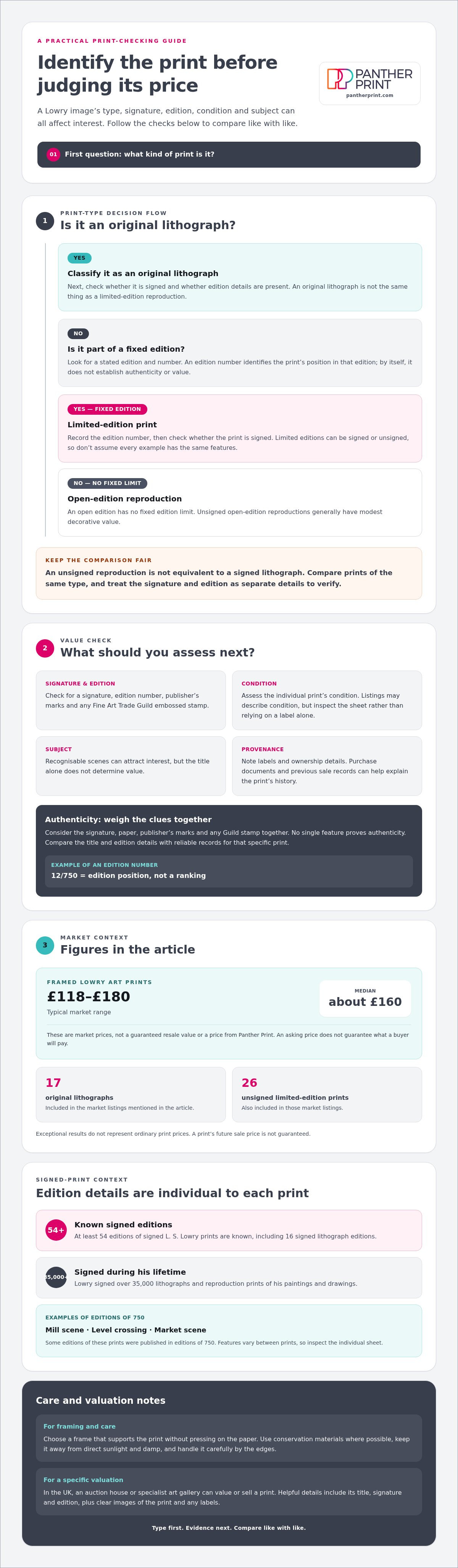
Unsigned open-edition reproductions generally have modest decorative value, while an original lithograph or signed limited edition can command far more. Market listings include 17 original lithographs and 26 unsigned limited-edition prints. For framed Lowry art prints, the typical market range is £118 to £180, with a median of about £160. These are market prices, not a guaranteed resale value or a price from Panther Print.
There is no guaranteed price for a print’s future sale. A gallery’s asking price reflects its own offer, while what a buyer is willing to pay depends on the edition, signature, condition and demand.
Popularity and Value Factors
Recognisable scenes can attract interest, but the title alone doesn’t determine a print’s value. Check whether it is signed or part of a limited edition, assess its condition, and look for provenance that supports its history. Compare like with like: an unsigned reproduction is not equivalent to a signed lithograph.
These exceptional results don’t represent ordinary print prices.
To frame and care for a print, choose a frame that supports it without pressing on the paper, and use conservation materials where possible. Keep it away from direct sunlight and damp, and handle it carefully by the edges.
In the UK, an auction house or specialist art gallery can value or sell a print. Provide its title, signature and edition details, along with clear images of the print and any labels, to help assess the specific work.
Signed limited-edition Lowry prints for sale
Signed editions stand apart from open-edition reproductions because an artist’s signature and edition details can affect interest and value. At least 54 editions of signed L. S. Lowry prints are known, including 16 signed lithograph editions. Collectors comparing Lowry prints should first identify the type of print.
Are Lowry prints original, limited-edition or open-edition? They can be any of these. An original lithograph differs from a limited-edition reproduction, while an open-edition reproduction has no fixed edition limit. Identifying the type helps you compare like with like.
Hand-signed editions and sale listings
During his lifetime, Lowry signed over 35,000 lithographs and reproduction prints of his paintings and drawings. Signed editions are described as hand-signed; some also carry a Fine Art Trade Guild embossed stamp or a publisher’s edition number. Features vary between prints, so inspect the individual sheet rather than assuming every detail appears on each example.
Some editions, including Mill scene, Level crossing and Market scene, were published in editions of 750. An edition number identifies a print’s place in that edition; it doesn’t alone establish authenticity or value.
Checking authenticity, edition and provenance
How can you tell if a print is authentic? Consider the signature, paper, publisher’s marks and any Guild stamp together, as no single feature proves authenticity. Compare the title and edition details with reliable records for that specific print.
To check the edition number and provenance, record the title, number, signature and any labels on the reverse. Then gather purchase documents, previous sale records and ownership details. A clear ownership history helps explain where the print came from; a number such as 12/750 describes its edition position, not its place in a ranking.
Some dealer-listed signed prints are described as 50-70 years old and in pristine condition. If you’re comparing collectible Lowry prints with decorative wall art, abstract canvas prints offer a different look.
Lowry's distinctive urban landscapes
L. S. Lowry made Britain’s industrial towns feel busy, human and instantly recognisable. His matchstick figures move through streets beneath factories, warehouses and smoking chimneys. The small figures bring scale to the buildings, while crowds turn ordinary journeys into scenes full of movement. In Coming Home from the Mill, painted in 1928, the mill and the people leaving it give the urban setting its daily rhythm.
Work and public life recur across his city scenes. Going to Work, painted in 1943, centres on people heading into an industrial day. St Augustine’s Church, Manchester, painted in 1945, shows how a familiar landmark can sit within the same lived-in townscape. Lowry’s streets aren’t empty backdrops: people, buildings and open spaces share the picture, making the city feel observed rather than staged.
His subjects also reach beyond factories. River Scene, painted in 1935, and Barges on a Canal, painted in 1941, bring waterways into the industrial landscape. The Sea, painted in 1963, shifts the setting again, showing the breadth of places Lowry chose to depict. These works help explain why his urban views feel distinctive: they capture different parts of everyday life, not just the mill town.
Look closely at the composition of Piccadilly Gardens, painted in 1954. Its named Manchester setting connects the scene with a recognisable public place, whilst the figures give it a sense of shared activity. Later, Meeting Point, painted in 1965, continued Lowry’s interest in people gathering within urban spaces. Together, these paintings offer a lively record of streets, landmarks and daily routines, with the matchstick figures giving each scene its unmistakable human scale.
Which Lowry prints are most popular?
There isn’t one subject that suits every admirer. Lowry’s familiar matchstick crowds, industrial streets and everyday gatherings each offer a different view of British life. Titles in signed-print listings include Industrial Town, Market Scene in Northern Town and Group of Children. Their subjects are a useful starting point when choosing a print for a room or collection.
For a city-centre feel, consider Great Ancoats Street. Its Manchester street name gives the scene a strong sense of place. Market Scene in Northern Town depicts a busy public setting, whilst Group of Children focuses on people and community. These examples show that Lowry’s appeal extends beyond factory views to streets, gatherings and familiar routines.
Collectors may also be drawn to titles such as The Fever Van, Our Town and The Contraption. Each has a distinct subject, so compare the image itself rather than relying on the title alone. Look at the number of figures, the setting, and the balance between buildings and open space. Then decide which scene suits your home or collecting interests.
To narrow your choice, first decide on the mood you want: crowded and lively, or quieter and more open. Then compare the print’s edition type, signature and condition. A signed limited edition appeals to collectors for different reasons than an unsigned reproduction chosen as wall décor. The title matters, but so do the specific edition and how the scene works in your space.
For an alternative focal point, browse artwork for your walls and compare styles before deciding which scene belongs in your home.
Panther Print: Abstract Canvas Prints
Panther Print offers Abstract Canvas Prints for readers who admire Lowry’s lively scenes but want a different look for their walls. Explore bold shapes, colour and movement to create a fresh focal point without choosing another industrial town scene.
Prefer a subject-led image? Browse Animals & Wildlife, Art for Kids & Nursery Art or Banksy Canvas Prints. Each brings a different kind of character to a room, whether you’re styling a family space or adding a striking feature to a quieter corner. Choose artwork that suits your room and the atmosphere you want to create.
Explore the available canvas print styles at Panther Print.
Choose art that feels at home
Start your next choice with the feeling you want in the room. Lowry prints bring a particular view of everyday life, while a different subject or style can shift the mood entirely. Consider the colours already around you, the space you want to fill and whether you’d prefer a calm accent or a lively focal point.
For a different direction, Panther Print offers Abstract Canvas Prints, Animals & Wildlife and Art for Kids & Nursery Art. Browse by subject and picture how each piece might sit alongside your furniture, lighting and favourite colours. You don’t need to match every detail. A well-chosen image can add contrast, warmth or a touch of fun.
Ready to explore artwork for your home? Visit Panther Print and browse the collection. Take your time, find a subject you enjoy seeing every day, and make the space feel more like yours.
Frequently Asked Questions
What are L. S. Lowry prints?
L. S. Lowry prints are printed versions of images based on the artist’s paintings and drawings. They include lithographs and reproductions, which may be signed or unsigned and issued as limited or open editions. A print isn’t automatically an original painting, even when it carries Lowry’s signature. Check the description and physical details to understand what kind of work you’re viewing.
How much do his prints cost in the UK?
Prices vary by title, print type, signature, edition and condition. These examples show why Lowry prints should be compared by title and edition. An asking price is not the same as a completed sale.
Where can I buy his prints in the UK?
Look for signed or limited-edition examples through UK auction houses and specialist art galleries, where listings describe individual works. For decorative canvas wall art, Panther Print’s online shop offers themed categories including Famous Artists and Printed Paintings. If you’re browsing Lowry prints, read each listing carefully to understand what the work is before choosing artwork for your home.