
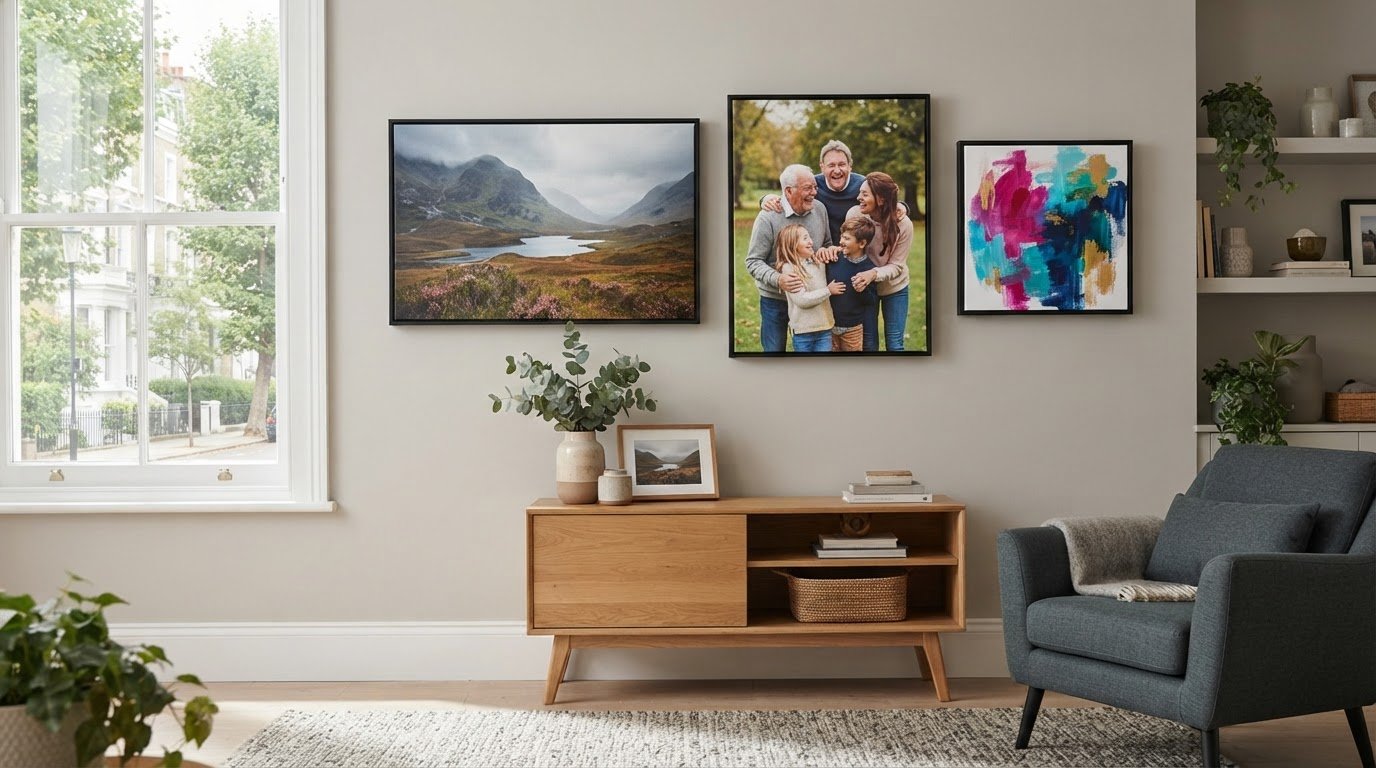
What if the photograph you love most doesn’t look quite right once it’s on the wall? Choosing photo on canvas prints involves more than picking a favourite image. The crop, orientation and composition can all change how it looks, while its colours and mood need to suit the room. A few careful checks can help you decide whether a treasured snapshot will work on canvas and in the space you have in mind.
This guide will help you choose an image and layout with confidence, and picture how the finished print could look at home or as a thoughtful gift. You’ll learn what makes a photograph work well on canvas, how to consider portrait, landscape and square compositions, and why details near the edge need extra care. You’ll also find practical ways to match your print to its setting. Panther Print’s bespoke photo-on-canvas service turns your chosen photograph into handmade wall art, ready to display without additional framing or installation.
Key Takeaways
- Choose a photograph with a clear subject, good focus and balanced lighting so its details come through on canvas.
- Decide whether one image or a group of related images best tells your story, then let the composition guide the format.
- Review the crop and edges before settling on a layout, especially if faces, text or meaningful objects are close to the borders.
- Consider the wall, nearby furniture and room colours to help your photo on canvas prints feel at home.
- Use a final order checklist to bring your chosen image and display setting together.
Why choose photo on canvas prints for personal wall art?
A photo-on-canvas print reproduces a personal photograph on canvas for display as wall art. It gives an image from your phone or album a place in your home, where you can enjoy it beyond a quick scroll. For a basic introduction to the format, see What is a canvas print?
A screen keeps a photograph close at hand, but a print gives it a place in your surroundings. At a larger scale, details such as someone’s expression, the colours in a landscape or a familiar corner of a favourite destination may become easier to notice. Its position also affects how you experience it, whether it becomes a focal point above a sideboard or part of a more personal arrangement.
Photo on canvas prints are a personal alternative to ready-made artwork when you want the subject to mean something specifically to you. The image might capture a family memory, mark a special occasion or bring back a favourite journey. It doesn’t need to be a flawless, professionally staged photograph. A candid moment can work just as well if it matters to you and has a clear composition.
What makes a photo canvas different from a photograph on screen?
A canvas print turns a digital image into a physical feature of your surroundings. Instead of tapping through dozens of pictures, you see one chosen moment as you move through the room. Consider the distance from which you’ll usually view it and the wall space around it. A close-up portrait may suit a smaller, more intimate spot, while a wide scene may have more presence on a broad wall.
Canvas also looks different from a photograph viewed on a bright screen. The finished appearance depends on the source image, its scale and how it fits the chosen format. Keep expectations realistic: enlarging a picture won’t add detail that wasn’t captured, and cropping can change the balance of the original. Choosing a suitable photograph matters as much as choosing the print.
When does a personal canvas print make a thoughtful choice?
Start with the memory, not a rule about what belongs on a wall. A family gathering, a celebration or a favourite travel photograph can each make meaningful decor when the image brings a moment to mind. You might choose a picture that reflects a shared story for a living space, or a familiar place that makes a quieter room feel more personal.
Then look beyond the memory to the photograph itself. Is the main subject easy to see? Does the image still feel balanced when you imagine it larger? A meaningful picture can be the right choice even if it isn’t technically perfect, but the composition still needs to work at the size and shape you have in mind.
Think of the choice as a short process: select an image, consider the format that suits its composition, then picture it in the room where it will be seen. Finally, review how the layout treats the photograph’s important details. Panther Print reproduces customers’ photographs on handmade canvas prints, ready to display without additional framing or installation. With the image and its intended place in mind, you can create a personal piece of wall art that feels considered.
How to choose a photograph that will work well on canvas
A favourite photograph can hold plenty of meaning, but it also needs to read clearly when enlarged and adapted to a canvas shape. Composition matters because the crop and format can change which parts of the photograph stand out and which details remain visible. Use this checklist to assess the image before considering file preparation or final dimensions.
Which details should you check before choosing your photograph?
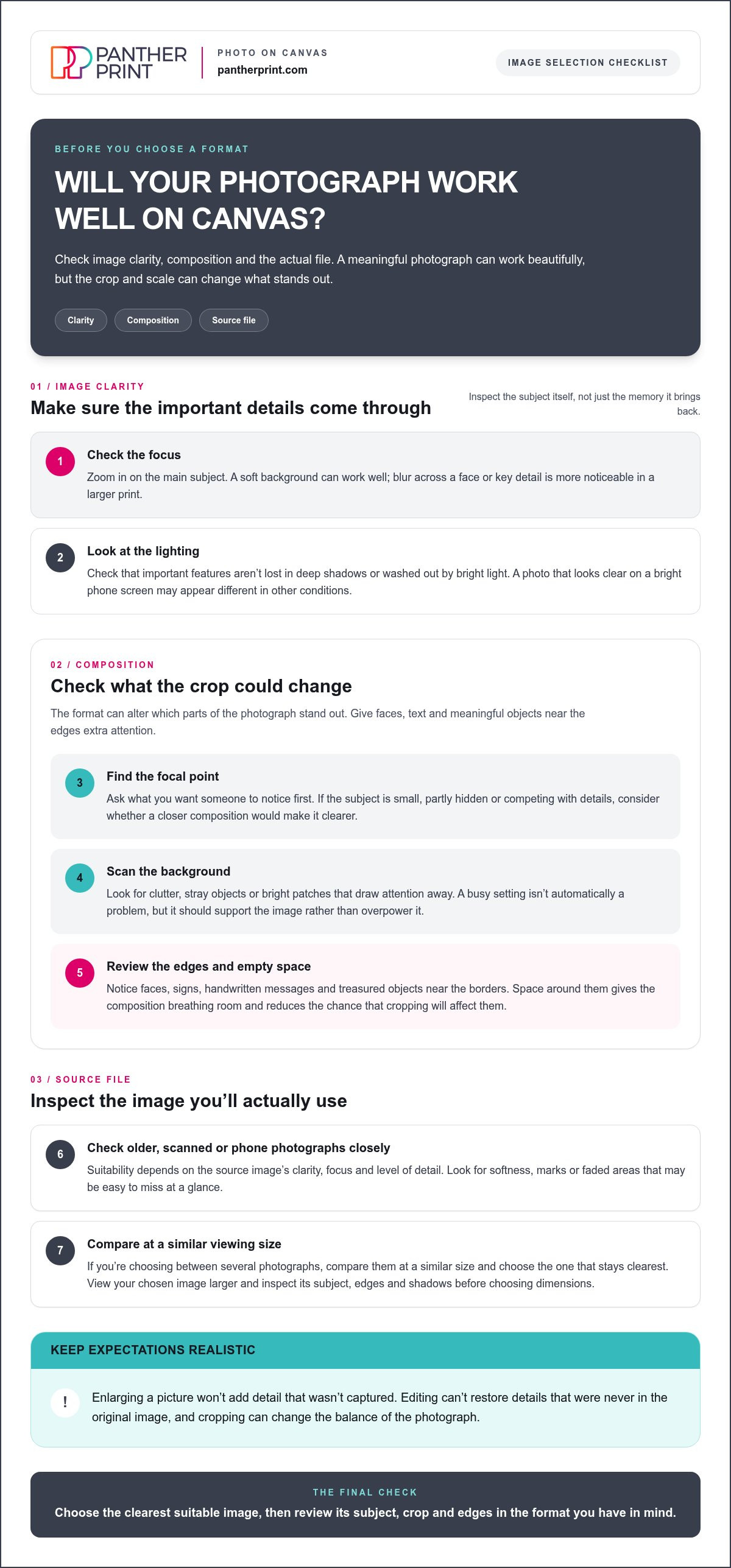
Look closely at the picture, not only at the memory it brings back. Check that the main subject is easy to recognise, then look for details around it that could distract or be cropped. Faces, signs, handwritten messages and meaningful objects may need extra space, particularly when they sit close to an edge.
- Check the focus. Zoom in on the main subject. A soft background can work well, but blur across a face or key detail is more noticeable in a larger print.
- Look at the lighting. Make sure important features aren’t lost in deep shadows or washed out by bright light. A photograph that looks clear on a bright phone screen may appear different in other conditions.
- Find the focal point. Ask what you want someone to notice first. If the subject is small, partly hidden or competing with several details, consider whether a closer composition would make it clearer.
- Scan the background. Look for clutter, stray objects or bright patches that draw attention from the subject. A busy setting isn’t automatically a problem, but it should support the image rather than overpower it.
- Check the edges and empty space. Identify faces, text and treasured objects near the borders. Space around these details gives the composition more breathing room and reduces the chance that cropping will affect them.
Can older, scanned or phone photographs work on canvas?
They can be suitable, but the result depends on the source image’s clarity, focus and level of detail. Inspect the actual file you plan to use. A small image saved from a message, for example, may retain less detail than the original photograph. Older scans can also contain softness, marks or faded areas that are easy to miss at a glance.
Before choosing dimensions, view the image at a larger size and inspect the subject, edges and shadows. This helps you judge its suitability; file preparation is a separate step. Don’t expect editing to restore details that were never captured. If you’re deciding between several images, compare them at a similar viewing size and choose the one that stays clearest.
Once you’ve settled on an image, choose a composition that gives its important details room. Panther Print’s bespoke photo-on-canvas printing turns customers’ photographs into handmade canvas prints, ready to display without additional framing or installation.
Compare photo canvas layouts, orientation and edge choices
The best layout gives your photograph room to tell its story. A wide beach scene, a close-up portrait and a collection of family snapshots each call for a different composition. When choosing photo on canvas prints, let the image guide the format rather than defaulting to the shape you usually prefer. As a starting point, a single image spotlights one moment, while a collage brings several moments together.
Single photograph or collage: which layout suits your idea?
Choose a single image when one subject or moment deserves attention. It keeps the composition clear and avoids crowding the details. A collage can bring related photographs together, such as snapshots from one celebration or different views from a trip. Look for a shared theme, colour or story so the pictures feel connected rather than competing. Make sure each image remains clear when viewed at the intended display size.
Use this comparison to decide which composition best suits your photograph:
| Layout | May suit | Consider |
|---|---|---|
| Single image | A standout portrait, landscape or special moment | Whether the subject has enough room around it |
| Collage | Several related memories you want to display together | Whether each image will remain easy to see |
| Portrait | A standing person, tall building or vertical scene | Whether the top and bottom of the subject have breathing space |
| Landscape | A wide family group, coastline or open view | Whether the key details are spread across the width |
| Square | A centred subject or balanced, compact composition | Whether a square crop would remove important details |
How do orientation and canvas edges affect the final look?
Let the photograph lead. Portrait orientation can suit a standing person or tall architectural view, while landscape gives a panoramic scene or group photograph room to breathe. A square format may work well for a centred subject, but can trim the sides of a wider picture. Before settling on a shape, imagine the crop and check that faces, scenery and other meaningful details still fit.
Edges matter too. Depending on how a canvas is designed, the image may continue around the sides, appear reflected there or meet a plain border. Each treatment changes what you see from the front and at an angle. If important details sit close to the photograph’s edges, allow for the possibility that they could wrap out of view. A plain or reflected edge can keep attention on the front, while a continuing image creates a more joined-up appearance around the sides.
Review the whole composition before ordering. Consider the front, crop and visible sides together rather than judging the centre alone. File preparation is a separate step; at this stage, focus on matching the image and format so the finished canvas feels balanced.
Match your photo canvas to its intended display
The photograph and its layout are only part of the decision. Picture the wall where the canvas will hang, what surrounds it and how people will usually see it. This helps you choose photo on canvas prints that feel considered in their setting rather than selecting a format in isolation. Start with the display area, then decide what you want the image to add.
What should you consider about the wall and room?
Look at the usable wall space and the visual details nearby. Note furniture, shelves, lamps and other artwork, then consider the usual viewing distance. A canvas seen across a room needs a clear overall subject; where people pause close by, smaller details may be more noticeable. Think about how much visual space the print should occupy without overwhelming its surroundings.
- Complement the room: Pick up a colour already present in the furnishings or decor for a connected feel.
- Add contrast: A photograph with a different dominant colour or darker tones can stand out against a lighter setting.
- Consider nearby art: Decide whether the canvas should echo existing colours and subjects or provide a deliberate change of pace.
There’s no single rule for matching colour. A vivid photograph can bring energy to a calm palette, while a softer image may sit comfortably amongst bold furnishings. Consider the display area as a whole: the image, available wall space, nearby objects and the distance from which it will be viewed.
How can the subject and mood guide placement?
Think about the feeling you’d like the image to bring to the space. Lively colours or an active scene can add a sense of movement; a quiet landscape may feel more restful. A sentimental photograph might suit a place where you’ll notice it often. These are starting points, not room-by-room rules. Choose what feels right for your home and the memory you want to display.
Then consider how the subject reads from different distances. If you’ll see the canvas both close up and across the room, check that the main image remains clear at a glance and that the details reward a closer look. A busy background may blend into the room from afar but compete with nearby decor when viewed up close. Let the wall and the way you use the space guide your choice.
If you’re drawn to wall art but don’t have a personal photograph in mind, Panther Print’s themed canvas art offers another option. Abstract canvas prints can bring colour, shape and visual interest to a room without centring on a personal memory.
Once you’ve settled on the image, layout and display setting, bring those choices together with Panther Print’s bespoke photo-on-canvas printing. The handmade print is ready to display without additional framing or installation.
Order photo on canvas prints with Panther Print
You’ve chosen a photograph and have a sense of where it belongs. Before you begin, bring the main decisions together. A little preparation keeps your order focused on the details that matter: the image, its composition and the space where you intend to display it.
What to have ready before starting your order
Use this final checklist to gather your choices without reopening every decision:
- Your chosen photograph: Have the image you want to turn into wall art ready, and make sure you’ve selected the version you intend to use.
- Your layout idea: Decide whether one photograph should take centre stage or whether a group of related images would tell the story better together.
- Your preferred orientation: Consider whether the composition feels best in portrait, landscape or square format. Let the picture’s shape guide you.
- Your display setting: Keep the intended wall and surrounding decor in mind, including the viewing distance and the feeling you want the artwork to bring.
- Details near the edges: Note any faces, text or objects close to the image borders. They may need extra care in the composition.
These are the main creative choices. File preparation is a separate part of the process, so keep your original photograph accessible and inspect its clarity before ordering. Focus on the choices that shape how the finished image will look rather than second-guessing every detail.
How Panther Print turns a personal photograph into canvas wall art
Panther Print’s bespoke service reproduces customers’ photographs on canvas, turning a personal image into wall decor. The prints are handmade and ready to display without additional framing or installation. Your chosen photograph can take its place in your home as a finished canvas print, without needing a separate framing service.
Before placing your order, connect the image with its intended composition and display area. Does the image suit the shape you have in mind? Will the important parts of the photograph remain visible? Does the subject feel right for the room or for the person receiving it? A quick review can help you feel settled about your choices.
Explore Panther Print’s photo-on-canvas service to turn a photograph that matters to you into handmade wall art.
Give a favourite memory a place to shine
The right photograph doesn’t have to capture a once-in-a-lifetime moment. It might show a small detail you love, a familiar view or a snapshot that still makes you smile. Choose an image you’ll enjoy seeing in your everyday surroundings, then let the wall you have in mind help shape the final choice.
With bespoke photo-on-canvas printing, Panther Print turns customers’ photographs into personal wall art. The canvas prints are handmade and ready to display without additional framing or installation, making them a thoughtful way to bring a meaningful image into your home or give someone a personal present.
Ready to give your chosen photograph a new place in your story? Create your photo on canvas print with Panther Print and make your memory part of your space.
Frequently Asked Questions
Can any photograph be printed on canvas?
The result depends on the image’s clarity and how well it suits the chosen dimensions. A sharp, well-lit picture usually holds more detail than a blurry or heavily shadowed one. Check the original file rather than a small preview in a messaging app. If you’re choosing between a few images, compare them at the same display size and select the one that stays clearest.
Can I print a black-and-white photograph on canvas?
Yes, black-and-white photographs can make striking canvas prints. Look for a good range of tones so dark areas don’t merge into one block and lighter details remain visible. A portrait with gentle light and a clear expression, for example, will give a different impression from a high-contrast city scene. Consider the colours and light in the room too: monochrome can sit quietly amongst existing decor or provide crisp contrast.
Can several photographs go on one canvas print?
A collage can bring several related photographs together in one composition, such as snapshots from a family celebration or a trip. Choose images that feel connected, and remember that each one will occupy less space than a single photograph. Favour pictures with a similar mood and avoid crowding the design so each moment remains easy to recognise.
Does a photo canvas need a separate frame?
No. Panther Print’s handmade photo canvases are ready to display without additional framing. They’re a straightforward choice if you want your photograph presented as canvas wall decor without planning a separate frame. Consider how the canvas will sit alongside nearby furnishings and artwork, then choose a composition that feels at home in that setting.
Is a photo on canvas a good gift?
It can be a thoughtful gift when the photograph reflects a memory or interest that matters to the recipient. A shared holiday snapshot, a much-loved family photograph or a picture of a meaningful place can make the gift personal. Consider whether the recipient would enjoy displaying that subject at home, and choose an image they’ll be happy to see as part of their everyday surroundings.
What happens if important details are close to the edge of my photograph?
Details near the edge may be affected by cropping or by the way the image sits around the canvas sides. Review the full composition before ordering, especially if faces, writing or objects need to remain visible. If the image feels tightly framed, a photograph with more space around the subject may be a better fit. Don’t assume every part of the outer edge will appear on the front.
How much detail does a photo need for a canvas print?
As a general guide, a resolution of around 150 to 300 DPI at the final print size is commonly recommended for canvas printing. This is not a Panther Print product specification, and usable detail also depends on the original image and how large it will be printed. A small file enlarged substantially may look softer, so inspect it at a larger view before deciding on dimensions.